JCS chief defines land mine incident as 'provocation'
South Korea's top military officer said Thursday that the United States has restricted some intelligence sharing on North Korea, but that the limits have not affected the South Korean military's overall readiness posture.
"Some information is restricted, but there is no problem in maintaining our overall readiness posture," Joint Chiefs of Staff Chairman Gen. Jin Yong-sung said during a National Assembly audit of the JCS held at the Ministry of National Defense headquarters in Seoul.
Jin was responding to main opposition People Power Party Rep. Sung Il-jong, who asked whether South Korea and the United States were currently sharing key intelligence related to North Korea's nuclear program.
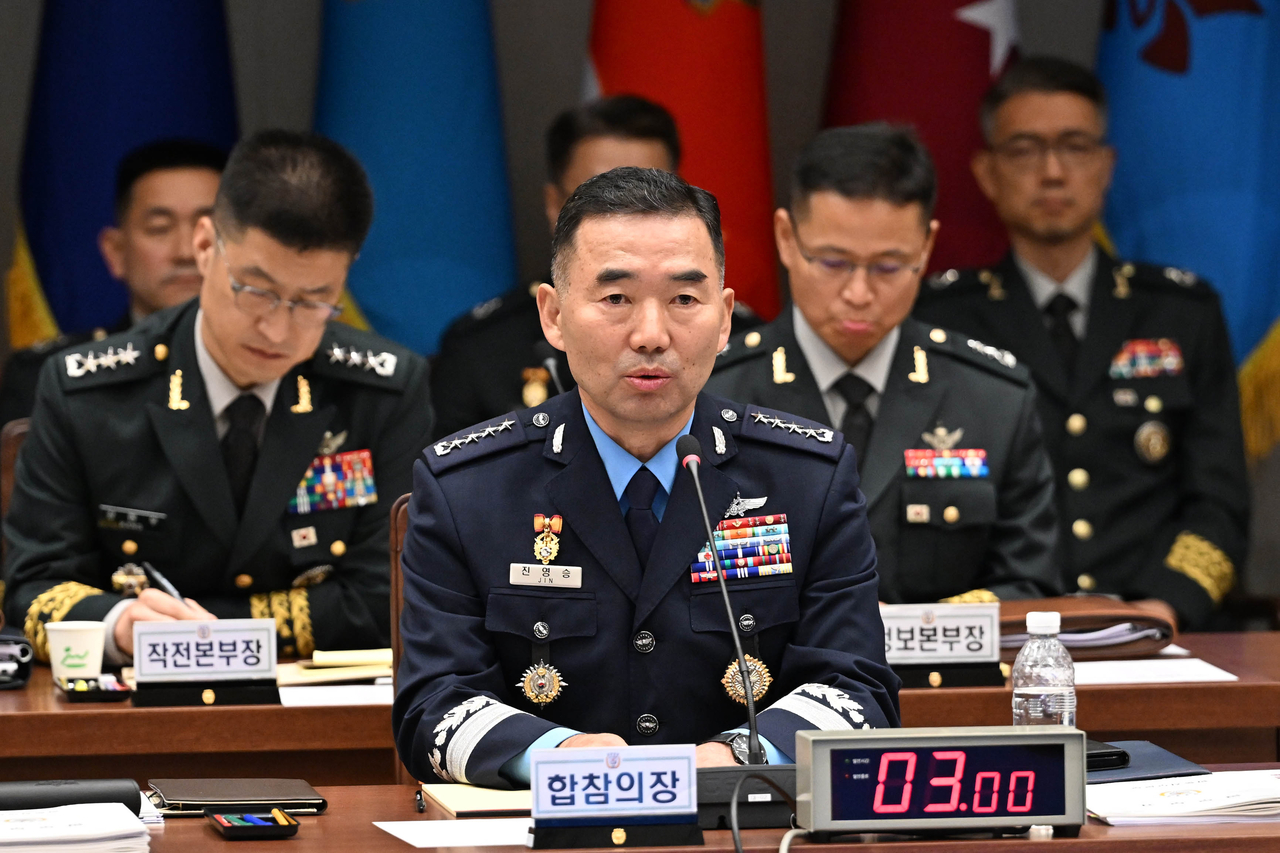
Asked how the military could maintain full readiness while some information sharing remained restricted, Jin said the limits did not extend to information needed to respond to imminent threats.
"There are different levels of managing situations, and it is not that information on imminent signs or various other matters at that level is not being shared," Jin said.
When Sung said he had been told that Washington was withholding important intelligence, Jin replied, "I do not think that is the case."
He added that resolving the situation would be the best outcome and that efforts were underway to do so.
The United States has reportedly restricted some satellite intelligence sharing on North Korea since March, following remarks by Unification Minister Chung Dong-young concerning a third uranium enrichment facility, sparking controversy on whether the information was classified.
Although neither side concluded that classified information had been leaked, the United States subsequently restricted some intelligence sharing with South Korea.
In late June, South Korea's National Intelligence Service was also reportedly excluded at Washington's request from a trilateral working-level meeting among South Korea, the United States and Japan on countering North Korean cyber threats.
Jin said he was not aware of the details of that case, but stressed that trilateral military cooperation remained close.
"Military cooperation among South Korea, the United States and Japan is being carried out in close coordination," he said.
North Korean mines
Lawmakers also questioned Jin over North Korean mines that exploded inside the Demilitarized Zone on Sept. 21, seriously injuring three South Korean military personnel.
Asked by People Power Party Rep. Lim Jong-deuk whether he considered the incident a North Korean provocation, Jin replied, "Yes."
Jin acknowledged that the word "provocation" had been omitted from the military's announcement of its investigation results, but said the omission did not reflect the military's assessment of the incident.
"With my subordinates seriously injured, there was not even 1 percent of me that thought this was not a provocation," Jin said. "I failed to pay close enough attention to the fact that the term 'provocation' was not included in the wording."
In his opening remarks at the audit, Jin also described the mine explosions as "a clear violation of the Armistice Agreement and a provocation threatening peace and stability on the Korean Peninsula."
JCS Vice Chairman Lt. Gen. Kwon Dae-won, who announced the investigation results, also rejected criticism that the military had avoided the term for political reasons.
"No one at the JCS judged that this was not a provocation," Kwon said.
Jin also acknowledged shortcomings in surveillance during the Sept. 21 operation, saying thermal observation devices and other surveillance assets should have tracked and monitored the area more closely.
"There were some shortcomings in that regard," he said.
He also said the military would stop using the term "terrain change area" for locations with suspected North Korean mine-laying, saying the phrase could cause misunderstanding.
Jin said the military would instead use clearer terminology such as "areas with suspected mine-laying."
flylikekite@heraldcorp.com
![[Survive&Thrive] Tips for getting around Seoul by subway (2)](https://wimg.heraldcorp.com/news/cms/2026/10/08/news-p.v1.20261006.1e7dee51d7f64cdba1a20b897d88cee6_T1.jpg?type=h&h=800)